A common misconception about a Rabby wallet download is that installing a browser extension is the main security decision. It is not. Installation is only the doorway; the more consequential choices come later, when a wallet interprets a transaction, connects to an unfamiliar decentralized application, or routes assets across several networks. Rabby is designed for Ethereum and EVM-compatible chains, and its value is best understood as a transaction-safety and network-navigation layer rather than simply another place to store tokens.
That distinction matters for US DeFi users. A wallet can hold a private key locally while still leaving the user vulnerable to a malicious approval, an incorrect chain, a deceptive token contract, or a bridge with different security assumptions. The practical question is therefore not just whether the Rabby wallet extension can be installed. It is whether the extension helps the user understand what is about to happen before signing—and where that protection necessarily stops.
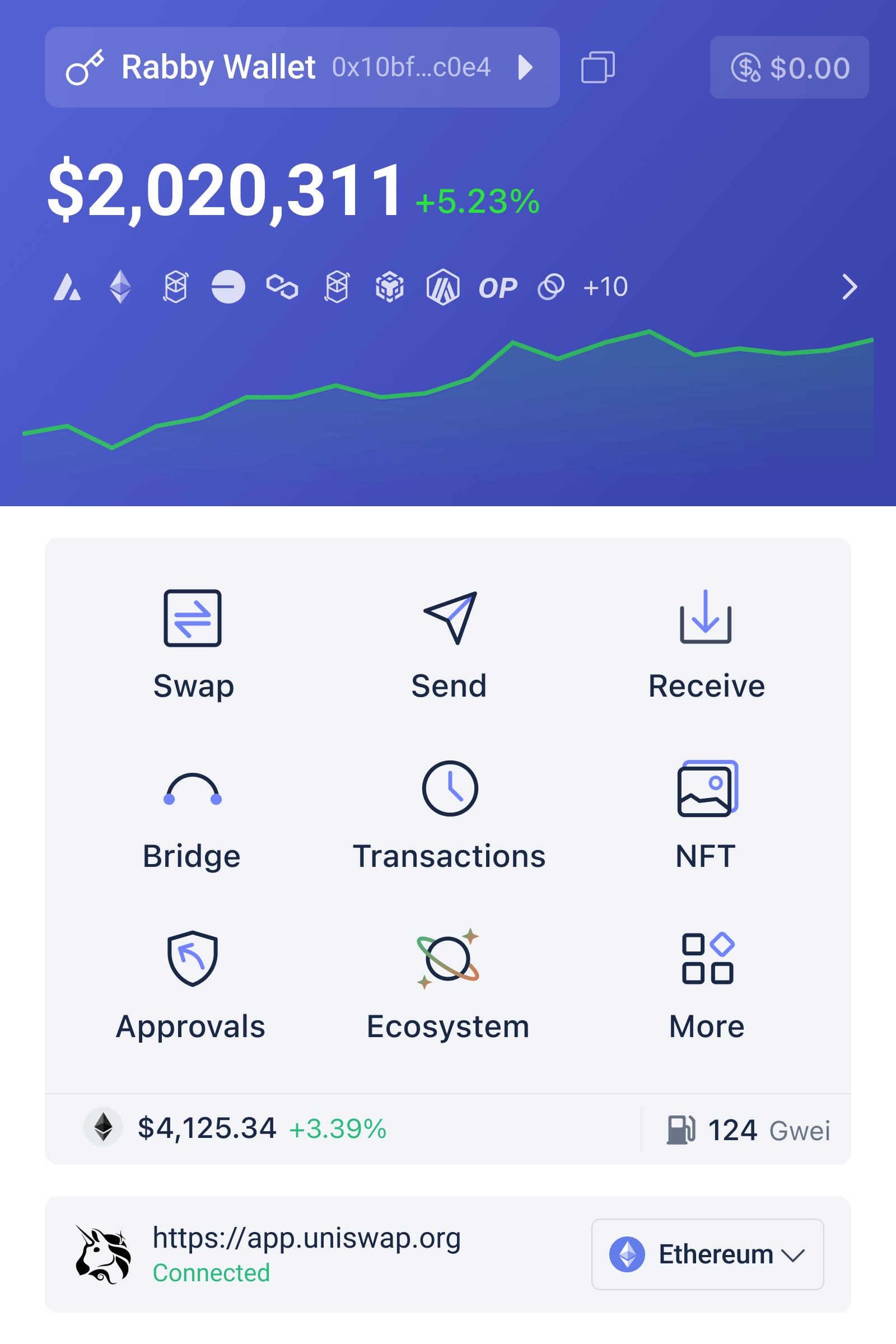
What the Rabby browser extension actually does
A browser wallet is an interface between a user, a private key, and web-based decentralized applications. When a DeFi site requests a connection, the extension helps present the wallet address and selected network. When the site requests a transaction, the extension passes the request to the wallet for review and signing. The blockchain still performs the transaction; Rabby does not replace the underlying network, smart contract, or consensus process.
Rabby’s focus on Ethereum and EVM chains is important because these networks share a broad execution model. A user may interact with decentralized exchanges, lending protocols, liquid staking applications, and other contracts across multiple chains while using familiar wallet standards. Recent project messaging has positioned Rabby as a wallet for Ethereum and all EVM chains. That broad scope can reduce the friction of managing several networks, but it should not be confused with identical risk. Two EVM chains may use different validators, bridges, fee markets, liquidity conditions, and emergency procedures.
One useful feature of a security-oriented wallet is transaction simulation or interpretation: before signing, the interface may attempt to show expected balance changes, approvals, or contract interactions in human-readable terms. This creates a sharper mental model than treating every request as an opaque block of technical data. Yet interpretation is not proof. A simulation depends on the wallet’s ability to understand the request and the current state of the relevant contracts. Complex, novel, or adversarial transactions may be difficult to represent perfectly.
Installing Rabby without turning setup into a blind spot
For users preparing a rabby wallet download, the safest process begins with source verification rather than speed. Use the project’s official distribution channel, confirm that the browser extension is the expected one, and avoid installers promoted through unsolicited messages, search advertisements, or copied social-media instructions. A fake extension can imitate branding while capturing a recovery phrase or redirecting transactions.
During setup, the recovery phrase deserves more attention than the extension itself. It is the root credential for a self-custody wallet: anyone who obtains it may be able to control the associated assets, while losing it can make recovery impossible. It should not be typed into a website, sent to support, stored in a screenshot, or kept in an online document. A hardware wallet can add an important layer by keeping key operations on a separate device, although it introduces its own responsibilities, including checking the device display and protecting its backup materials.
After installation, separate everyday activity from high-value custody where practical. A wallet used for testing a new protocol or claiming an unfamiliar reward does not need to contain long-term holdings. This is not a claim that multiple accounts eliminate risk; they limit the blast radius of a mistake. A malicious approval signed by a trading account is still serious, but it need not expose assets held in a separate, more carefully managed account.
Cross-chain swaps: why the phrase can mislead
“Cross-chain swap” sounds like a single operation, but it can describe several mechanisms. In one design, a user swaps on one network, transfers an asset through a bridge, and then swaps again on the destination network. In another, a liquidity provider or routing system coordinates the exchange across chains. Some systems rely on wrapped representations, while others use messaging or settlement mechanisms with different trust assumptions.
The wallet may make the workflow feel unified, but the underlying risks remain distributed. A cross-chain transaction can involve a source-chain swap, a bridge or messaging step, a destination-chain transaction, and one or more token approvals. Each component adds possible failure modes: insufficient liquidity, slippage, delayed finality, contract bugs, an unsupported token representation, or a destination transaction that requires additional gas.
This leads to a non-obvious point: a smoother interface can improve safety by reducing confusion, but it can also encourage users to underestimate complexity. A quote that looks attractive may exclude network fees, bridge costs, price impact, or the cost of acquiring native gas on the destination chain. The cheapest displayed route is not necessarily the cheapest completed route. For a US user, dollar-denominated estimates can also change quickly when token prices move between quotation and settlement.
Before approving a cross-chain route, inspect the source and destination networks, the asset being sent, the asset expected in return, the estimated amount after slippage, and the contracts receiving approval. Confirm that the destination token is the intended representation rather than an imitation with a similar ticker. If the route requires a bridge, ask what happens if the message is delayed or the destination transaction fails. The answer depends on the specific protocol; a wallet cannot guarantee that a third-party bridge will behave safely.
Myths versus reality in wallet security
Myth: A readable transaction preview makes every transaction safe
Reality: A preview is a decision aid, not an insurance policy. It can reveal suspicious approvals or unexpected balance changes, but a user still needs to recognize whether the application and contract make sense. If the preview is incomplete, inconsistent, or unexpectedly complex, the correct response is to pause rather than sign quickly.
Myth: EVM compatibility means chains are interchangeable
Reality: Compatibility usually refers to the execution environment and developer tooling, not equal security or liquidity. Network congestion, validator structure, bridge design, token standards, and recovery options can differ materially. A wallet that supports many chains makes access easier; it does not homogenize their risks.
Myth: Disconnecting a site revokes token permissions
Reality: Connecting a wallet and granting a token allowance are separate actions. Disconnecting may remove a site’s current interface access, but it does not necessarily revoke an approval already recorded on-chain. Users should review and revoke unnecessary allowances through a trusted method, while recognizing that revocation itself is a transaction requiring network gas.
A practical framework for using Rabby in DeFi
Think in three layers. First is identity: which account and network are active? Second is authorization: what contract is being allowed to move or use assets? Third is execution: what balances, fees, and destination outcomes are expected after the transaction? Many wallet mistakes happen because users check only the first layer—“the address looks right”—while ignoring authorization and execution.
For small experimental transactions, this framework can be applied quickly. Verify the domain and network, read the requested approval, compare the expected output with the quote, and leave enough native gas for the next action. For larger transfers, slow down and test the route with a modest amount first. A test cannot prove that a protocol is safe, but it can expose wrong networks, unsupported assets, and operational friction before more capital is committed.
The most useful near-term signal for multi-chain wallets is not simply how many networks they list. Watch whether transaction explanations become more accurate for complex contract calls, whether routing makes fees and failure conditions clearer, and whether users can distinguish approvals from ordinary swaps. If those improvements occur, wallet interfaces may become a meaningful layer of DeFi risk management. If not, broader chain coverage may mainly increase convenience without reducing underlying exposure.
FAQ
Is Rabby a blockchain or a decentralized exchange?
No. Rabby is a cryptocurrency wallet interface for Ethereum and EVM-compatible networks. It can connect users to decentralized applications and help them review transactions, but the trades and contract actions occur through the relevant blockchain protocols.
Can Rabby guarantee that a cross-chain swap will succeed?
No. Success depends on the swap provider, bridge or messaging system, liquidity, network conditions, token contracts, and destination-chain execution. Rabby can help present transaction details, but it cannot remove the technical and economic risks of third-party infrastructure.
What should I do if a transaction preview looks unexpected?
Do not sign immediately. Check the application, active network, recipient or contract, token amount, approvals, and expected result. If the request remains unclear, reject it and investigate through trusted project channels. Confusion is itself a useful warning signal.
Is a browser extension suitable for long-term holdings?
Suitability depends on the user’s security practices, threat model, and amount at risk. For significant long-term holdings, many users consider hardware-backed signing or separate cold-storage arrangements. Whatever setup is used, the recovery phrase and signing decisions remain central responsibilities.
